
Google Opal: Build Mini-Apps with Natural Language

Google Opal is a new AI-powered tool from Google Labs that allows you to build "mini-apps" and automated workflows using simple, natural language commands. Unveiled in a U.S. beta, it represents a significant step in the "vibe-coding" movement—prioritizing an application's function and feel over rigid syntax.
We’re excited to announce Opal, a new experimental tool from Google Labs that lets you build and share powerful AI mini apps that chain together prompts, models, and tools — all using simple natural language and visual editing. Opal is a great tool to accelerate prototyping AI ideas and workflows, demonstrate a proof of concept with a functional app, build custom AI apps to boost your productivity at work, and more. We’re launching it today and are so excited to see what you build. Google Developer Blog
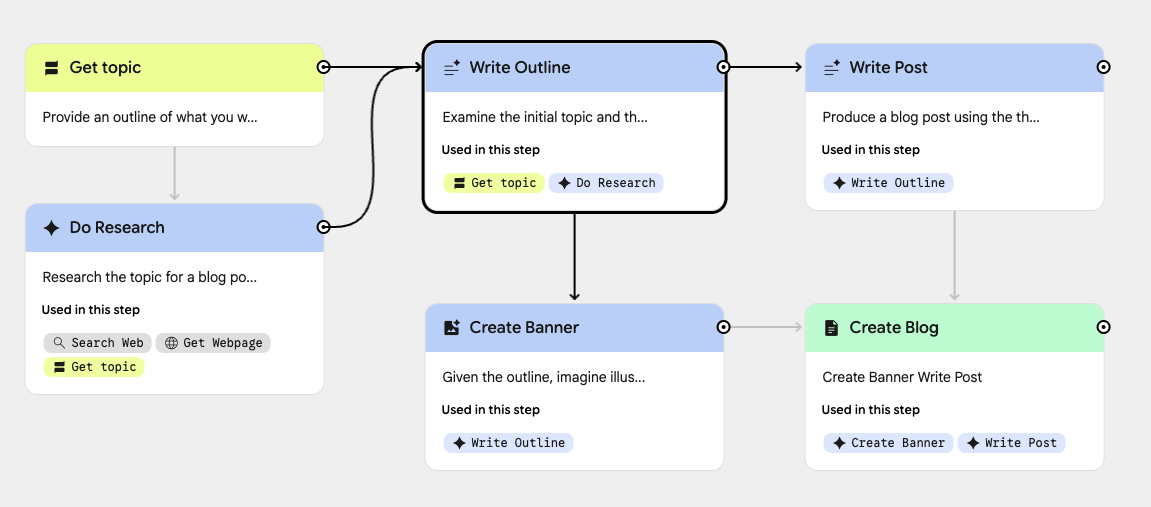
At its core, Opal translates your descriptions into a visual workflow, demystifying the app's logic. This transparent, node-based editor allows you to see the inputs, AI generation steps, and outputs, turning you from a user into a director. The platform is powered by a suite of Google's premier models:
- Gemini 2.5 for text and logic generation.
- Veo 3 for creating dynamic video with audio.
- Imagen 4 for context-aware image creation.
To get started, you can select from pre-built templates or "remix" them through conversational prompts or by manipulating the visual editor. Once an app is ready, it can be shared instantly with a URL, similar to a Google Doc.
Practical Applications: From Idea to Prototype in Hours
Early adopters have praised Opal for its speed and intuitive design, which radically accelerates the journey from concept to functional prototype.
Personal use example
You can create apps to auto-summarize daily news into a personalized email digest, draft replies to difficult emails, or generate study flashcards.
Business use example
A small business can generate product descriptions and then use that same text to create a promotional video. Teams can build simple CRMs, project dashboards, or marketing assets in minutes, automating workflows that once required significant manual effort.
Key Concerns & Limitations
As a beta product, Opal presents several challenges and open questions:
- Intellectual Property: Who owns an application built with Google's proprietary models and hosted on its servers—the user or Google? This ambiguity is a major hurdle for business adoption.
- Abstraction Risk: The platform's simplicity may lead you to build tools for complex problems without fully grasping the underlying logic, potentially resulting in errors or misuse.
- Technical Constraints: Opal currently lacks direct database connections, third-party API integrations, and robust user authentication, limiting its use to simpler applications.
While Google frames Opal as a tool for empowerment, it raises questions about whether it will de-skill development or free up engineers to focus on more complex architectural challenges.
Future Trajectory: Integration and a New Economy
Opal's future will be shaped by user feedback. A successful beta could lead to a wider international rollout and, more importantly, deep integration with the Google ecosystem. The ability to deploy Opal apps directly within Google Workspace (Gmail, Drive, Sheets) or connect them to Google Cloud services could fundamentally reshape business productivity.
Further ahead, we may see the emergence of an "Opal App Store," creating a marketplace for creators to share and monetize their AI-powered mini-apps.
Conclusion: A Shift in Software Creation
Google Opal is more than a new no-code tool; it's a philosophical bet on natural language as the future of human-computer interaction. It aims to make app creation universally accessible, empowering anyone with an idea to build a solution. The revolution isn't just about code—it's about making creation itself conversational.